
I had forgotten how much I missed listening
Today began with a very good introduction call.
About a dozen members of 26Eight joined Pete Hollenhorst with the Loewe / Cabasse US team to learn more about Cabasse: its history, its engineering legacy, and the role that high-performance HiFi has always played in the company’s design and development.
That history matters. Cabasse was founded in France in 1950 by Georges Cabasse, an electrical engineer, music lover, and descendant of generations of French luthiers. His ambition was not simply to manufacture loudspeakers. It was to reproduce music without alteration, coloration, or distortion, and to preserve the emotional force of the original performance.
The company’s record includes early coaxial loudspeakers developed for CinemaScope presentation, active three-way monitors selected for Radio France, the extraordinary La Sphère, and decades of research into coaxial driver geometry, controlled directivity, active amplification, and digital signal processing.
That is the historical background. But this is not a history lesson, and it is not a conventional review of another disconnected audio component.
This is a System Review.
Full disclosure: I wasn’t expecting this
I had heard about Cabasse, and I understood that the speakers now in my home were quite expensive and very good.
I am used to living with, selling, installing, and appreciating significant HiFi systems, some of which could be considered among the finest available in the world.
Twenty years ago, this same position in my home was occupied by a system built around Wilson Audio WATT/Puppy 3/2 loudspeakers, a Jeff Rowland Design Group integrated amplifier, a Theta Digital transport and DAC, a REL Stadium subwoofer, and Transparent Audio cables.
I am not a newcomer to HighEnd two-channel HiFi.
For most of my career, I may have been considered an audiophile snob, and I was proud of that.
These days, I consider myself a recovering audiophile. Even with my understanding of Cabasse’s reputation, I did not have much confidence that the Pearl Akoya speakers were going to rise to a truly HighEnd performance level.
Well, I was pleasantly surprised.
These modern works of art do, in fact, operate at a truly HighEnd level.
More importantly, it became something personal.
I sat quietly and listened to music. I didn’t get any work done this afternoon! Luckily, this review actually is work-adjacent…
That sentence sounds almost embarrassingly simple. But I realized how long it had been since I had allowed myself to do it, without working, testing, designing, answering, building, or being “busy.” I had forgotten how much I missed sitting in a room and letting music be the only thing demanding my attention.
The Cabasse Pearl Akoya gave that experience back to me.
“Just” two stand-mounted speakers
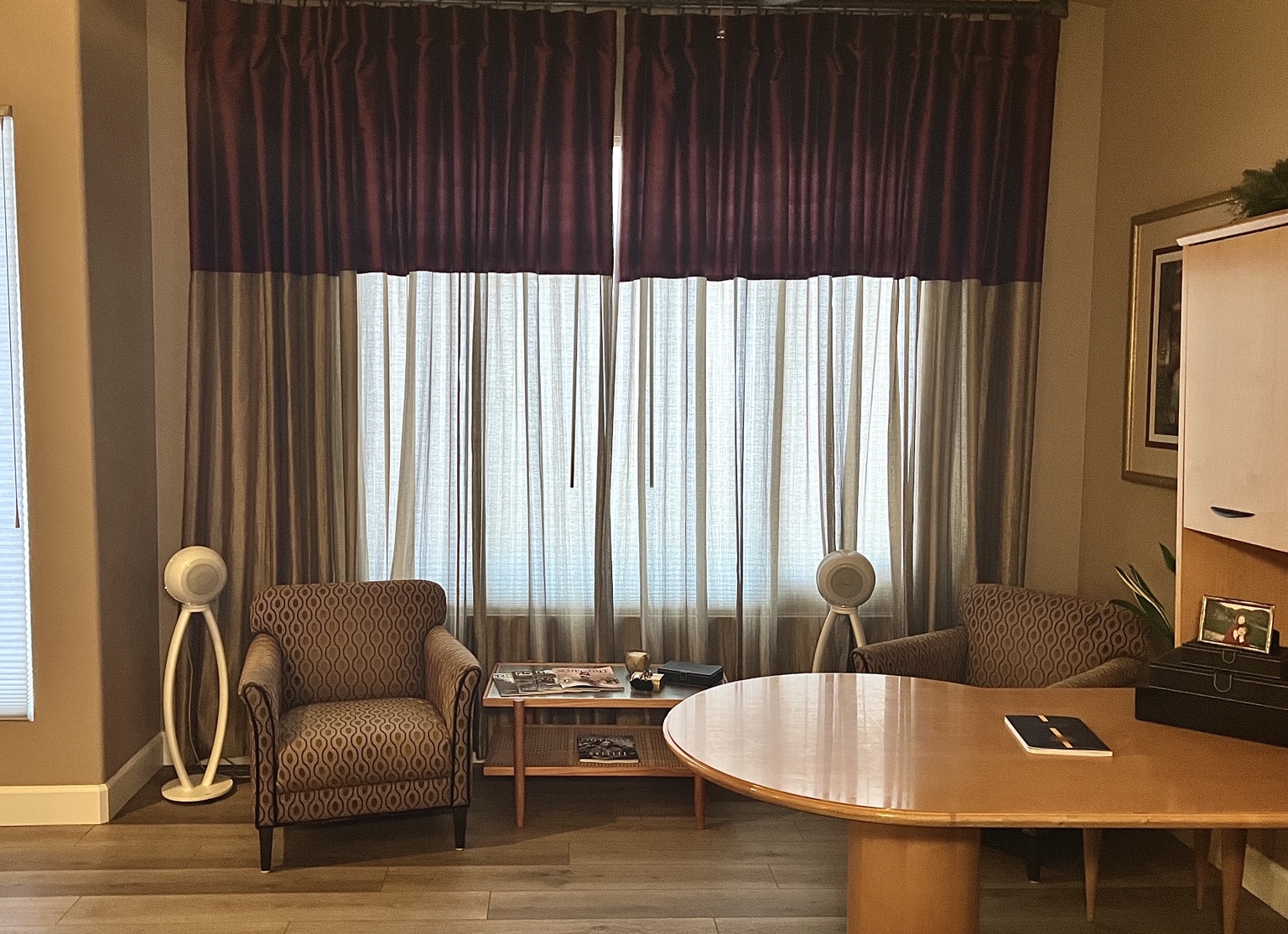
My new Cabasse system appears to be “just” a pair of speakers on stands.
There is no large equipment rack. There are no monoblock amplifiers on the floor. There is no preamplifier, outboard DAC, streamer, room-correction processor, or bundle of expensive speaker cables connecting one collection of boxes to another.
In my installation, the only visible cables are the two power cords.
That visual simplicity hides what the Pearl Akoya actually is. Each compact sphere is a complete active connected audio system. Cabasse has integrated the streaming platform, digital processing, amplification, crossover behavior, and drivers so they operate as one engineered whole rather than a collection of separate boxes.
The important result is not the size of the numbers on the specification sheet. It is the reserve, control, and composure the system has when the recording asks for them.
The full verified specifications are collected at the end of this review. What mattered while listening was that the technology never became the event.
A real room, not an audiophile shrine
Look at the photograph.
This is my home office. It is a comfortable working room with desks, chairs, windows, draperies, tables, cabinets, hard surfaces, soft surfaces, and all the compromises of an actual lived-in home.
It is not an acoustically engineered laboratory. The furniture was not selected to flatten a response graph. My listening chair has not been bolted to a mathematically perfect location. The room still has to function as an office tomorrow morning.
Cabasse’s onboard calibration and DSP helped the Pearl Akoya settle into that reality. Placement still matters and the laws of acoustics remain stubbornly employed, but serious performance did not require the room to become a servant of the system.
That is important. A system that only works after it takes over the architecture is not simple, no matter how elegant its components may be.
The room became the stage
We were not confined to a tiny, approved listening position.
We spent much of the evening in the family room toward the back of this part of the house. From there, singers, guitarists, and drummers sounded as if they were performing in the front room.
I walked through the house while the music played. It remained surprisingly loud, clear, and coherent away from the speakers, particularly in the hallways. I did not take laboratory measurements, so I will not pretend that a walk through my own house is a controlled directivity test. But the experience was unmistakable.
That behavior also fits Cabasse’s long emphasis on spherical forms and coaxial driver geometry. The design is intended to preserve coherence as direct and reflected sound interact with a real room. I cannot turn my hallway into a laboratory, but I can tell you that the music did not sound as if it were merely leaking out of an office at the front of the house.
It sounded as though the performance had taken possession of that entire part of our home.
When the review became a date
Well, my love returned from a sales trip tonight, and we unexpectedly fell into one of our own.
There was no formal listening checklist. We did not sit with clipboards, swap cables every 45 seconds, or reduce music to a sequence of approved audiophile sound effects.
We followed the music wherever it led us.
We began with five different interpretations of “Wild Horses,” then drifted into the hazy intimacy of Mazzy Star’s “Fade Into You.” Stevie Ray Vaughan’s “Riviera Paradise” opened the room. Dada’s “Dorina” and The Jayhawks’ “Save It for a Rainy Day” carried us somewhere else again.
Joe Henry’s “Sparrow” brought calmness and space, but also the physical weight of the kick drum. That combination stayed with me: quiet without thinness, delicacy without losing mass.
Greg Brown’s “The Poet Game” reminded us what texture and humanity in a voice can do. Kansas gave us “Carry On Wayward Son,” “Icarus—Borne on Wings of Steel,” and “Dust in the Wind,” moving from scale and drive to the simple clarity of strings and voices.
Diana Krall’s “Besame Mucho” and Jennifer Warnes’ “Famous Blue Raincoat” slowed the room down again.
Then we played Sting’s “Fields of Gold” and followed it with Eva Cassidy’s interpretation. The Pearl Akoya let us hear the interplay between lead and rhythm guitar while keeping the song whole. The details were present, but the system did not hold them up like evidence. They remained part of the performance.
Then came the clear tones of Eva Cassidy singing “Over the Rainbow.”
At some point, without deciding to, we settled into our own private Eva Cassidy concert.
We had stopped reviewing the system.
We were simply together, listening. For three hours! I can’t remember the last time that happened.
That is where the evening became our own .
The difference was not a specification. It was not volume, resolution, bandwidth, or amplifier power considered in isolation.
It was the ability of the system to make music important in the room without making the system itself the center of attention.
That simplicity changes where serious HiFi can belong. A client does not necessarily need a dedicated listening room, an equipment rack, visible cable architecture, or a floor full of black boxes to have a meaningful musical experience. An office, sitting room, bedroom suite, or family space can become a place where people actually stop and listen.
For Custom Integrators and HiFi dealers, that is not a lesser category. It is an opportunity to put meaningful music back into rooms that conventional audio systems have stopped reaching.
The verdict
The Cabasse Pearl Akoya convinced me on performance. But the strongest thing I can say about it is not technical.
It made me sit quietly and listen to music again.
Then my love came home, sat with me, and the review became a date.
The system disappeared into the experience it had created.
A listening session became .
Brought to us by the HiFi Renaissance™.
You take my breath away, Songbird.
With appreciation and full credit to Rob Skuba, creator of “,” for the idea that inspired our “.”
Review system and verified specifications
- System: Two Cabasse Pearl Akoya active high-resolution connected speakers on Cabasse stands
- Configuration: Wireless stereo pair; power connection to each speaker
- Architecture: Three-way tri-coaxial active system
- Amplification per speaker: 1,050 W RMS / 2,100 W peak
- Amplification allocation: 300 W RMS high-frequency; 300 W RMS midrange; 450 W RMS bass
- Stereo-pair total: 2,100 W RMS / 4,200 W peak
- Drivers: 13 cm coaxial BCI midrange-tweeter; 17 cm HELD woofer
- Frequency range: 30 Hz–27 kHz
- Maximum stated output: 115 dB mono peak / 121 dB stereo peak
- Room adaptation: Cabasse CRCS automatic calibration and onboard DSP
- Digital conversion: 768 kHz / 32-bit DAC; high-resolution playback support up to 24-bit / 192 kHz
- Connectivity: Ethernet, Wi-Fi, Bluetooth, optical S/PDIF, 3.5 mm analog input, Micro-USB
- Dimensions and weight: Approximately 220 × 220 × 220 mm; 8 kg per speaker
Disclosure and source note
This is an experiential system review based on Loren Roetman’s listening session at home on August 28, 2026. Cabasse were introduced to members of the 26Eight network by Pete Hollenhorst with the Cabasse / Loewe US team. The relationship provides the opportunity and context for the review; the listening observations and conclusions are Loren’s own.
Product specifications and historical details were checked against Cabasse’s official Pearl Akoya product literature and official company history. Subjective observations, including room-to-room clarity, imaging, tonal character, bass weight, and the emotional experience of the session, are presented as firsthand listening impressions, not laboratory measurements.